


Confidence in Growth: A Billion-Dollar Lesson from Elon Musk
The Event: A Signal of Conviction
Recently, Tesla CEO Elon Musk made headlines not for a new product launch but for a powerful financial move: he personally purchased $1 billion worth of Tesla stock
- $1 Billion = Approximately ₹8,300 Crores.
This rare acquisition of 2.57 million shares is a strong signal of his confidence in the electric-vehicle maker’s future despite market volatility.
For context: this single investment is 100 times larger than his last purchase in 2020.
It isn’t just news—it’s a masterclass in asset allocation and conviction.
The Data: Investing at a Peak?
| Metric | Value |
| Share Price | ~$421.62 |
| 52-Week High | $488.54 |
| 52-Week Low | $212.11 |
| P/E Ratio | 224.2 |
| Market Cap | $1.35 Tn |
On the surface, buying more shares at these levels looks counter-intuitive. Yet Musk’s focus is not on today’s P/E ratio but on tomorrow’s earnings growth. The stock was already up more than 25% in three months—and he still bought more.
Lesson: Time in the market often beats timing the market.
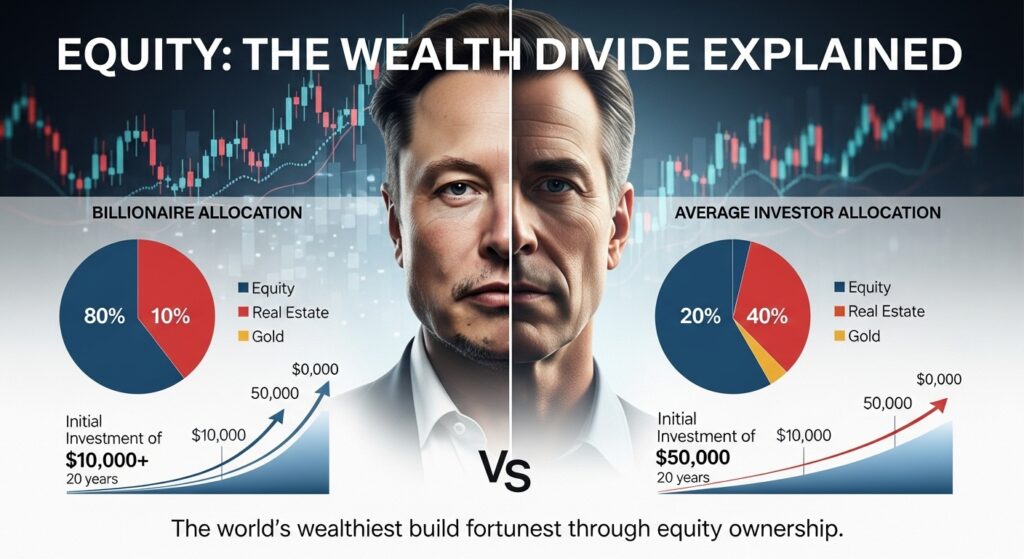
The Strategy: Extreme Focus on Equity
Musk’s personal balance sheet is a case study in concentrated conviction:
- >90% Allocation to Equity
- Minimal Exposure to bonds, gold or real estate
- Cash held mainly for operational needs, not as a long-term “safe” asset
He isn’t diversifying away from his wealth in other asset class like Real estate, Gold or Debt; he’s doubling down on what he knows best—and believes will create the most value.
The Wealthiest Think in Equity
Warren Buffett (Berkshire Hathaway), Larry Ellison (Oracle) and now Musk—all have the vast majority of their net worth tied to the companies they built or believe in. They understand that equity ownership is the primary engine of wealth creation.
Key Question: “If the world’s wealthiest individuals attribute their success to equity ownership, why is my allocation so conservative?”
Investor Self-Assessment: Are You Aligned for Growth?
Ask yourself:
- What is my current equity allocation? Is it 20–30% while 60–70% sits in ‘safe’ assets that barely beat inflation?
- Am I ready to think like a builder? With India’s robust reforms and growth prospects, can I cultivate the conviction of a Musk or Buffett?
- Am I trying to time the market or give time to the market? Musk didn’t wait for a dip—he invested on long-term conviction.
- How do I define “high exposure”? Is ₹10 lakhs or ₹1 crore in equity meaningful relative to my total net worth?
- Am I systematically investing? Do I have SIPs in quality mutual funds or stocks to harness compounding over time?
- What is the opportunity cost of caution? What future wealth am I missing by staying under-allocated to equity?
Key Takeaways & Action Points
- Wealth is built in equity, not preserved in cash. The greatest wealth-creation stories are rooted in ownership (equity), not debt (bonds) or speculative assets (gold).
- Valuation matters, but growth drives return. Don’t let a high P/E alone scare you away from quality companies or funds with strong growth potential.
- Redefine your risk. The biggest risk may not be a market correction but falling short of your goals because of an overly conservative portfolio.
- Emulate the masters, not the masses. The masses flock to safety; the masters build and invest in growth. Review your asset allocation and consider systematically increasing your equity exposure for long-term wealth creation.
Conclusion
Elon Musk’s billion-dollar bet is more than a headline—it’s a powerful reminder of where true confidence lies. In a growing economy like India, the real question isn’t “Should I invest?” but “Can I afford not to have a meaningful allocation to equity?”
Review your portfolio. Increase your systematic investments. Cultivate the conviction of an owner. Your future self will thank you for it.
Disclaimer: This case study is for educational purposes only and is not a recommendation to buy or sell any security. Please consult your financial advisor before making investment decisions. Past performance is not indicative of future results.
